Before you sign with a marketing agency: 9 questions from someone who's seen the inside
 By Prasenjit Pati, Founder, Mithminds8 min read

You’ve probably been here. You paid for a website, some ads, maybe a monthly SEO package. Someone promised it would bring in customers. Months later, you’re still not sure what’s working, what you’re paying for, or who to ask.
If that sounds familiar, you’re far from alone. In a study of Australian small businesses and their digital marketing providers (opens in new tab), published in 2024 by the University of the Sunshine Coast and the Small Business Ombudsman, one in three owners surveyed ended up in a formal dispute. Nearly three in four owners stayed with their provider for less than a year. And half said their provider pushed them towards services they didn’t need.
I spent more than three years at a marketing agency serving business owners in Australia and the UK. I was on the sales calls and saw the proposals go out. Most of the problems owners run into are visible before they sign, if they know what to ask.
These are the nine questions to ask a digital marketing agency before you sign. I’d put them to any agency, including mine. For each one you’ll find why it matters, what a good answer sounds like, and the red flag to watch for.
Why so many agency relationships go wrong
Before you choose a digital marketing agency, it helps to know what usually breaks. The Ombudsman’s research and what I saw from the inside point to the same three things:
- The agency sells what it has, not what you need. A package with SEO, ads and social media looks impressive. It just may not fix the thing that’s actually holding the business back.
- Nobody connects the marketing to the business. Reports show reach, impressions and likes. The owner wants to know if the phone is ringing.
- Nobody explains things properly. The study found providers often didn’t spell out risks, timeframes or what results to expect. Owners didn’t always know the right questions to ask, so the gaps only showed up later.
Every question below is aimed at one of those three problems.
1. “What do you think my business needs, and what don’t I need?”
This is the most useful question you can ask, because it shows whether the agency has thought about your business at all.
A good answer comes back with questions of its own. What are your goals for the next 12 months? Where do your best customers come from now? What have you already tried? A good agency will often tell you to hold off on something. (“Your Google Business Profile needs fixing before we spend a dollar on ads.”)
Red flag: a recommendation that matches their biggest package, delivered before they’ve asked you anything. One owner in the Ombudsman’s study summed it up: “They made a lot of assumptions and they didn’t ask me too many questions.”
2. “Who will actually do the work, and do they know my industry?”
The person who sells to you is often not the person who does the work. At larger agencies, accounts are passed to whoever has capacity.
I once watched a social media marketer manage an NDIS provider’s account without knowing the difference between core and capacity building supports. I also saw ads planned for a business in Epping by someone who couldn’t tell you where Epping is in Melbourne. Neither person was bad at their job. They just didn’t know the client’s world, and it showed in the work.
A good answer names the person, tells you what they’ve worked on before, and lets you speak to them before you sign.
Red flag: “Our team will look after you,” with no names. Also ask how long that person is likely to stay on your account. Agencies have high staff turnover: in Australian media agencies, about one in four staff left for another agency in the year to September 2023, according to the Media Federation of Australia’s industry census (opens in new tab).
3. “How will this connect to my business goals?”
A marketing goal and a business goal can look alike, but they aren’t the same. More followers is a marketing goal. More booked jobs, more appointments or a fuller pipeline is a business goal.
A good answer links each piece of work to a number you care about: enquiries, bookings, calls from Google Maps, cost per lead or sales. It also tells you how that number will be measured, for example call tracking or form tracking in Google Analytics. (Here’s how we approach setting up tracking that shows what’s working.)
Red flag: a plan built entirely around reach, impressions and engagement, with no mention of leads or sales.
4. “What can’t you promise me?”
This one surprises people, and the answer tells you a lot.
Some results are outside anyone’s control. Google says so itself: “No one can guarantee a #1 ranking on Google.” (Google Search Central (opens in new tab)) Ad results depend on your offer, your pricing and your competitors as much as on the agency.
A good answer is honest about what’s uncertain. It gives you a realistic range, explains what could get in the way, and tells you when you should expect to see early signs.
Red flag: guaranteed rankings, guaranteed ROI, or numbers like “300% more leads” with nothing behind them.
5. “Whose name will my accounts be in?”
This is the question owners skip most often, and the one that causes the most pain when a relationship ends.
Your domain name, website, hosting, Google Ads account, Meta ad account, Google Business Profile and analytics should all belong to your business. The agency should be given access, not ownership.
For your domain, you can check this yourself in two minutes. Look up your website address on auDA’s free .au WHOIS tool (opens in new tab). The registrant listed should be your business, with your ABN or ACN.
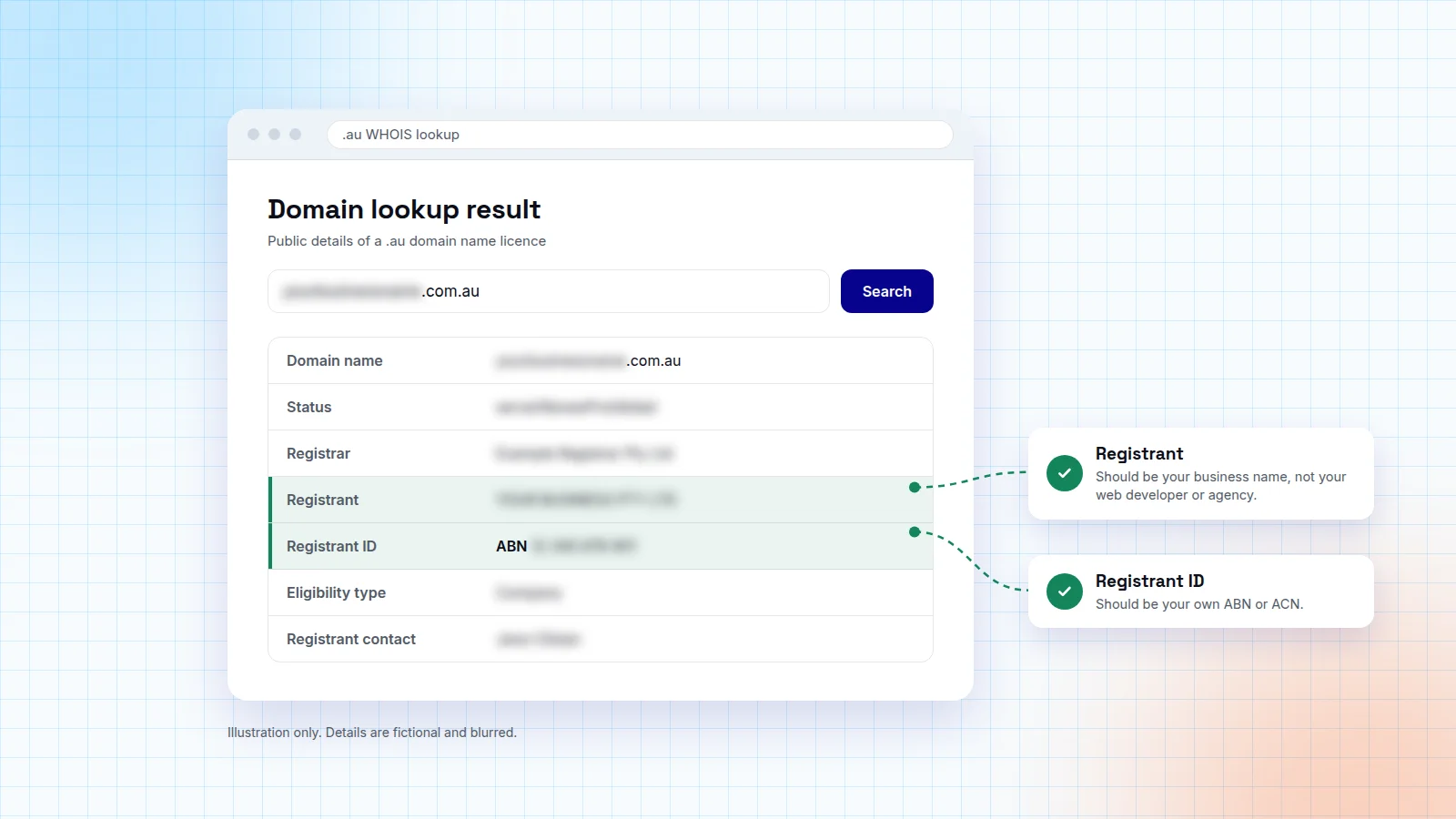
A good answer is “everything is set up in your name, and you can remove our access at any time.”
Red flag: “We’ll set it all up under our account to make things easier.”
6. “What exactly is included, and what costs extra?”
Vague scope is how small invoices become big ones. “Social media management” can mean three posts a month or daily posting with ads and replies to every comment.
The Ombudsman recommends that any agreement spell out (opens in new tab) the scope of work, timelines, all fees, how results will be reported, how either side can exit, how disputes are handled, and how passwords and assets are handed back.
A good answer is a written proposal that lists every deliverable, every cost and every timeline.
Red flag: a single monthly fee with a one-line description, or “we’ll work that out as we go.”
7. “What will your reports look like, and will I understand them?”
Ask to see a real example report, with the client’s details removed.
A good answer is a short report in plain English. It covers what was done, what changed in the numbers you care about, what didn’t work, and what happens next.
Red flag: a 20-page export of charts with no explanation, or reports that only ever show good news.
8. “How quickly do you reply, and who do I contact?”
According to the study, one of the two main reasons owners contact the Ombudsman about digital marketing providers is that the provider can’t be reached.
A good answer gives you a specific reply time, a named contact, and the hours they’re available.
Red flag: a general support inbox, or “we’ll get back to you” with no timeframe.
9. “What happens if we part ways?”
Nobody likes to plan the breakup at the start. But a clear exit is a sign of a confident agency, not a nervous one.
Ask what notice is required, what happens to work you’ve already paid for, and how your logins, files and content will be handed back.
It’s also worth knowing your rights. Since 9 November 2023, unfair terms in standard form small business contracts (opens in new tab) are illegal in Australia. That can include terms that let only one side end the contract or change its terms.
A good answer is clear, written and fair to both sides.
Red flag: heavy penalties for leaving early, or an agency that keeps your content or accounts when you go.
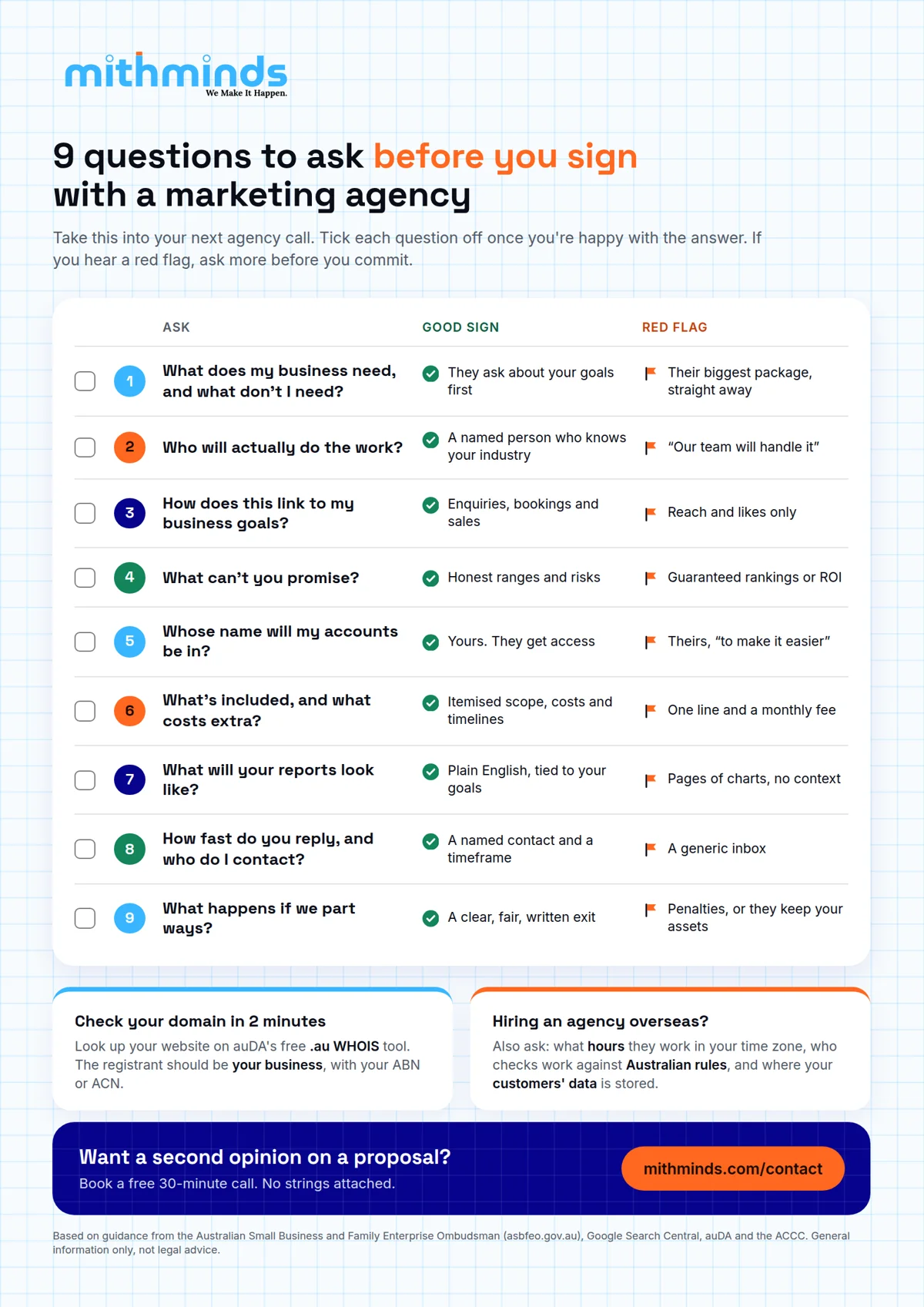
A quick checklist to take into your next call
Want it on paper? Download the one-page checklist (PDF) (opens in new tab), print it, and tick each question off on your next agency call.
| Question | Good sign | Red flag |
|---|---|---|
| What do I need and not need? | They ask about your goals first | Their biggest package, straight away |
| Who does the work? | A named person who knows your industry | “Our team will handle it” |
| How does this link to my goals? | Enquiries, bookings, sales | Reach and likes only |
| What can’t you promise? | Honest ranges and risks | Guaranteed rankings or ROI |
| Whose name are the accounts in? | Yours, with their access | Theirs, “to make it easier” |
| What’s included? | Itemised scope and costs | One line and a monthly fee |
| What do reports look like? | Plain English, tied to goals | Pages of charts, no context |
| How fast do you reply? | A named contact and a timeframe | A generic inbox |
| What if we part ways? | Clear, fair, written exit | Penalties, or they keep your assets |
 Download the printable checklist (PDF, 1 page)
(opens in new tab)
If you’re considering an agency outside Australia
Plenty of Australian businesses work with teams overseas, and it can work well. Mithminds is based in Kolkata, India, so this is something I’m asked about often. Add three questions to the list above:
- What hours will you be available in my time zone? Get specific times, not “flexible hours”.
- Who checks that the copy and campaigns suit Australia? That means Australian English, and the rules that apply to your industry, such as ACCC advertising rules, the Spam Act and the Privacy Act.
- How do you handle my customers’ data? Ask where it’s stored and who can access it.
A good offshore partner will answer all three without hesitating.
If things have already gone wrong
If you’re already in a relationship that isn’t working, start with your contract and raise the issue in writing. If you can’t resolve it, the Australian Small Business and Family Enterprise Ombudsman (opens in new tab) has a free dispute support tool and can help you work out next steps.
How we approach this at Mithminds
I started Mithminds because I wanted to work the way these questions describe. Every engagement starts with a free 30-minute call about your goals. Then I do a free business review covering your business, your market and your competitors, and you get a written proposal by email with the plan, the work involved and the outcomes to expect, each with a timeline. Everything we set up stays in your name. (Why business owners work with us.)
The call, the business review and the proposal are free, with no strings attached. Feel free to bring this list and ask me every one of these questions.
Frequently asked questions
What should I ask a digital marketing agency before hiring them?
Ask what they think your business needs and doesn't need, who will do the work, how the work links to your business goals, what they can't promise, whose name your accounts will be in, what's included and what costs extra, what reports look like, how fast they reply, and what happens if you part ways.
Can a marketing agency guarantee first page on Google?
No. Google states that no one can guarantee a #1 ranking. An agency can improve the things that influence rankings, like your website, your content and your Google Business Profile, but it can't control Google's results.
Who should own my website and ad accounts?
Your business should. Your domain, website, hosting, Google Ads, Meta ad account, Google Business Profile and analytics should all be in your business's name, with the agency given access. You can check who holds your .au domain using auDA's free WHOIS tool.
What should a marketing agency contract include?
The Small Business Ombudsman recommends covering the scope of work, timelines, all fees, how results will be reported, exit terms, dispute resolution, and how passwords and assets will be handed back.
Is it a good idea to hire a marketing agency based overseas?
It can be, as long as they're available during your business hours, write for the Australian market, follow the Australian rules that apply to your industry, and handle your customers' data properly. Ask about all four before you sign.